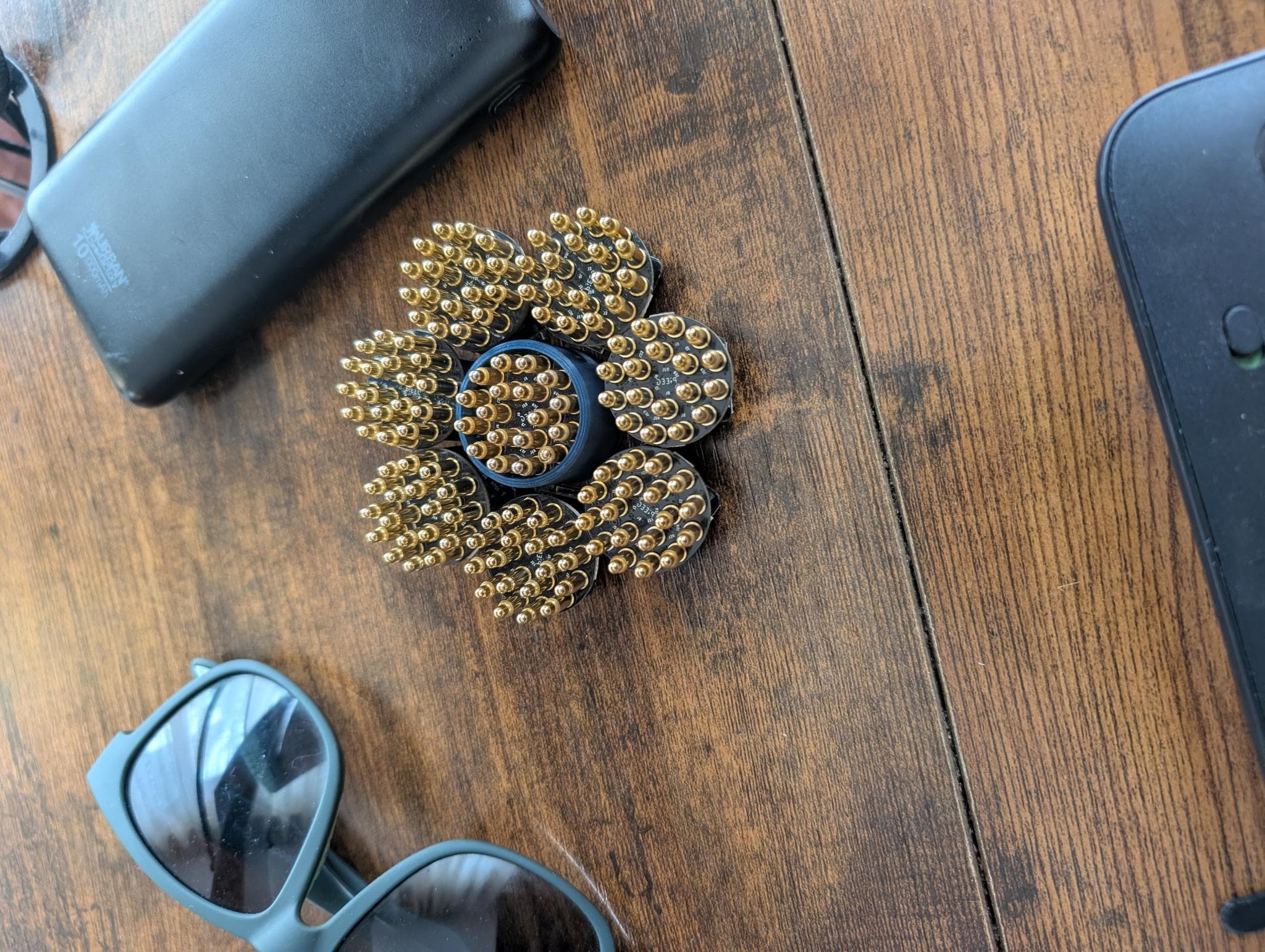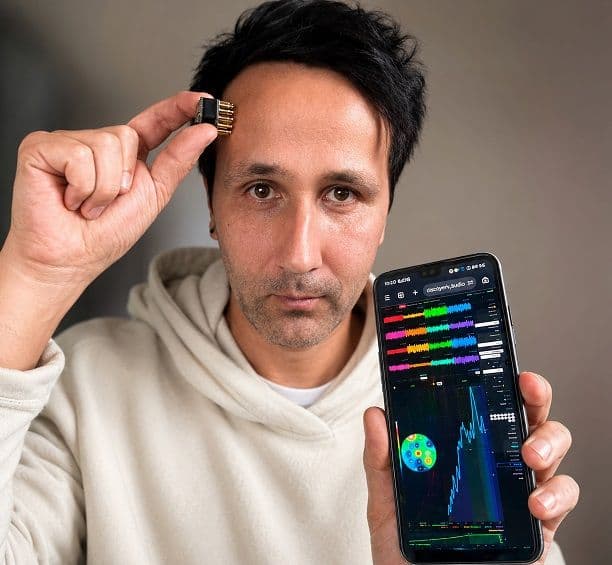
Because Octopus-16 packs 16 24-bit biosignal channels into a self-contained 26 mm footprint, it opens up an architectural question that bulky desktop amplifiers could never ask: what if high-density biosignal hardware were tiled from identical snap-together cells rather than wired to a single central box?
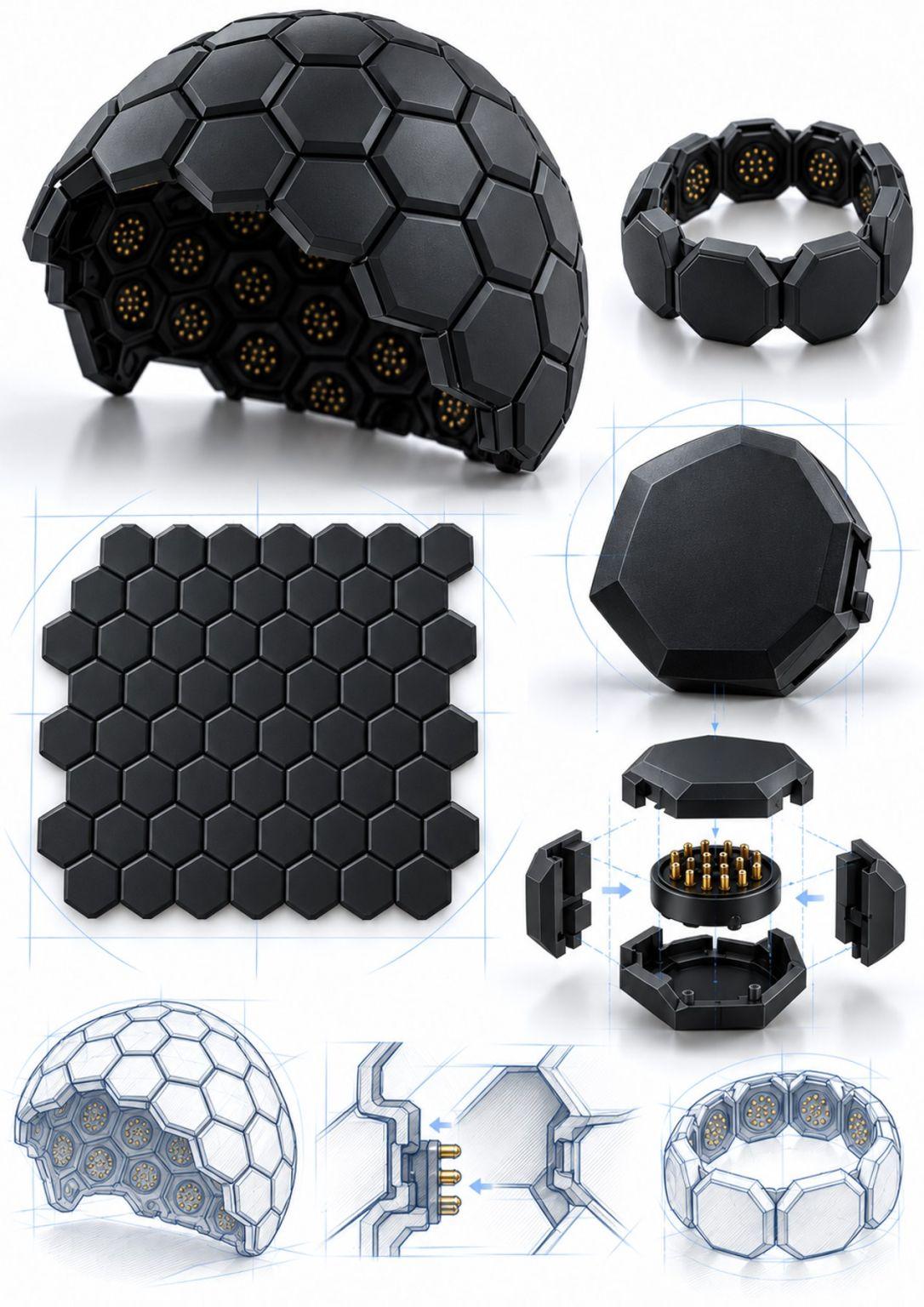
We are exploring an early-stage honeycomb-inspired modular wearable concept in which each hexagonal cell houses one 16-channel Octopus-16 acquisition node—scaling up to 64 interconnected modules (1,024 potential channels) across reconfigurable geometries.
One Cell, Multiple Wearable Geometries
Rather than manufacturing a fixed-purpose device for each anatomical site, hexagonal cells could assemble into experiment-specific form factors:
- Full-Scalp Helmet: High-density non-invasive EEG arrays for spatial brain mapping and source-imaging research.
- Forearm or Limb Sleeve: Dense surface-EMG grids for motor-unit decomposition, prosthetic control, and fine finger kinematics.
- Torso Belt or Flexible Patch: Multi-site electrophysiological recording across respiratory, cardiac, and postural muscle groups.
Open Engineering Challenges Ahead
To be completely transparent: this is an early architectural exploration, not a finished 1,024-channel product. Turning a tiled cellular array into a scientific instrument requires solving substantial engineering problems—including sub-millisecond clock synchronization across independent ADCs, aggregate wireless/bus bandwidth, power distribution, uniform mechanical scalp pressure, and automated channel topology discovery.
Building in public lets us tackle those constraints alongside researchers who need adaptable, affordable high-density arrays. Following our 48-channel Kraken Link release, modular tiling represents the long-term horizon of that roadmap.