
PIEEG Low-cost Brain-computer interface (EEG, EMG, and ECG)


PIEEG Low-cost Brain-computer interface (EEG, EMG, and ECG)
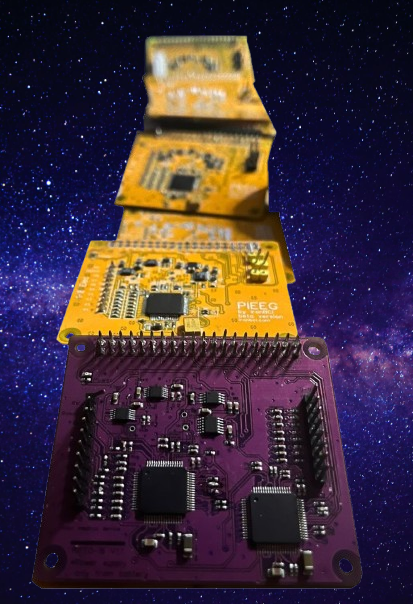
or years, the PiEEG team has been dedicated to breaking down the barriers of neuroscience. We believe that measuring the human body’s signals—whether it’s the brain (EEG), muscles (EMG), or eyes (EOG)—shouldn’t be restricted to high-cost equipment.
Our mission is to make PiEEG the universal bridge between biology and technology for research porpuses. Designed for simplicity and compatible with a vast range of electrodes, our open-source hardware lets you go from unboxing to data-tracking in minutes. If you can run a Python script, you can explore the human nervous system.
PiEEG is a project born from a shared interest in hardware engineering, signal processing, and neuroscience. Our team consists of researchers and engineers who believe that the tools for exploring biosignals should be accessible to everyone.
Over the years, we have contributed to the field by publishing our findings on Brain-Computer Interfaces (BCIs) and developing open-source hardware. Our goal isn’t just to build devices, but to provide a transparent platform where others can experiment and build their own neural interfaces. By combining our experience in hardware design with machine learning, we work to ensure PiEEG remains a reliable, entry-level tool for non-medical research and exploration.

Ildar Rakhmatulin. PhD. Scientist, Engineer, and Entrepreneur in bioscience | Instructor Udemy
With a strong academic background in the UK (Imperial College, Heriot-Watt University, Edinburgh University), Ildar has published numerous papers on topics including deep neural networks for EEG feature extraction, low-cost brain-computer interfaces, and applications of artificial intelligence in various fields. His work has been widely cited, demonstrating his significant impact in the field of neurotechnology and BCI research. He started PiEEG on the CrowdSupply platform and raised 5 times more than initially planned.
Join to
Would you like to receive news?